Two voices, one struggle
A lecture by Mai Al Bayoumi and Mona Borghei held in the Lecture Theatre of the Faculty of Social Sciences in Valencia on 18 June 2026
The original text of this presentation was written in Spanish, and its translation and proofreading have been carried out automatically using artificial intelligence tools. We apologise to our readers for any errors that may be found.
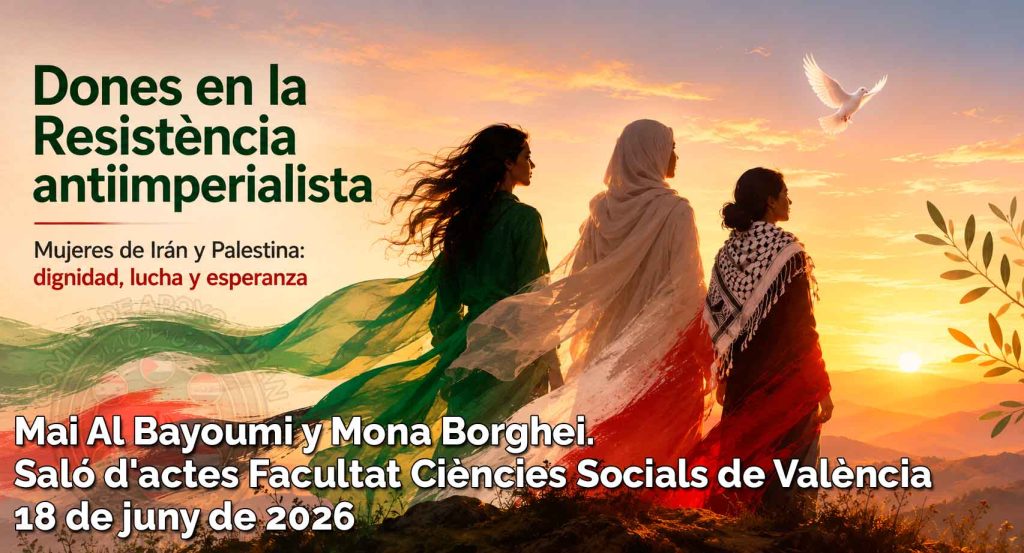
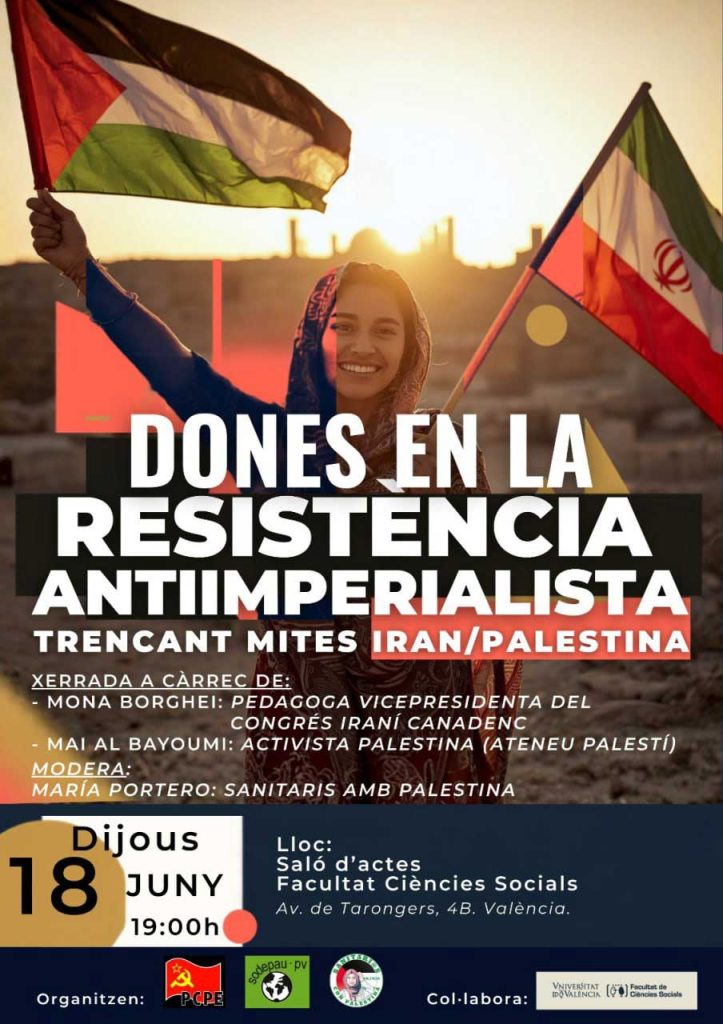
On 18 June 2026, the Faculty of Social Sciences in Valencia hosted an event that was no ordinary lecture. Under the title ‘Women in Anti-Imperialist Resistance: Debunking Myths about Iran and Palestine’, two women, two voices and two national experiences shared a common thread: anti-imperialism and resistance.
Mona Borghei, an educator, lecturer in Persian literature and Iranian activist, and Mai Al Bayoumi, a Gazan activist, engaged in dialogue from their respective realities to dismantle the hegemonic narratives that the West has constructed about their peoples. This was not merely an exchange of views, but a documented account, underpinned by data and personal experiences, on what it means to be a woman in a country subjected to sanctions, wars and foreign intervention.
This document records Mona’s speech, faithful to her script and her voice, whilst reserving space for Mai’s words. Together, they offer a perspective that is essential for understanding the present and, above all, for ensuring we do not forget that resistance has a woman’s face.
This text faithfully reflects the content of the talks given by Mai Al Bayoumi and Mona Borghei, based on their original script and the transcript of their presentation, with the aim of providing an informative, rigorous and accessible account, without losing the power or depth of their message.
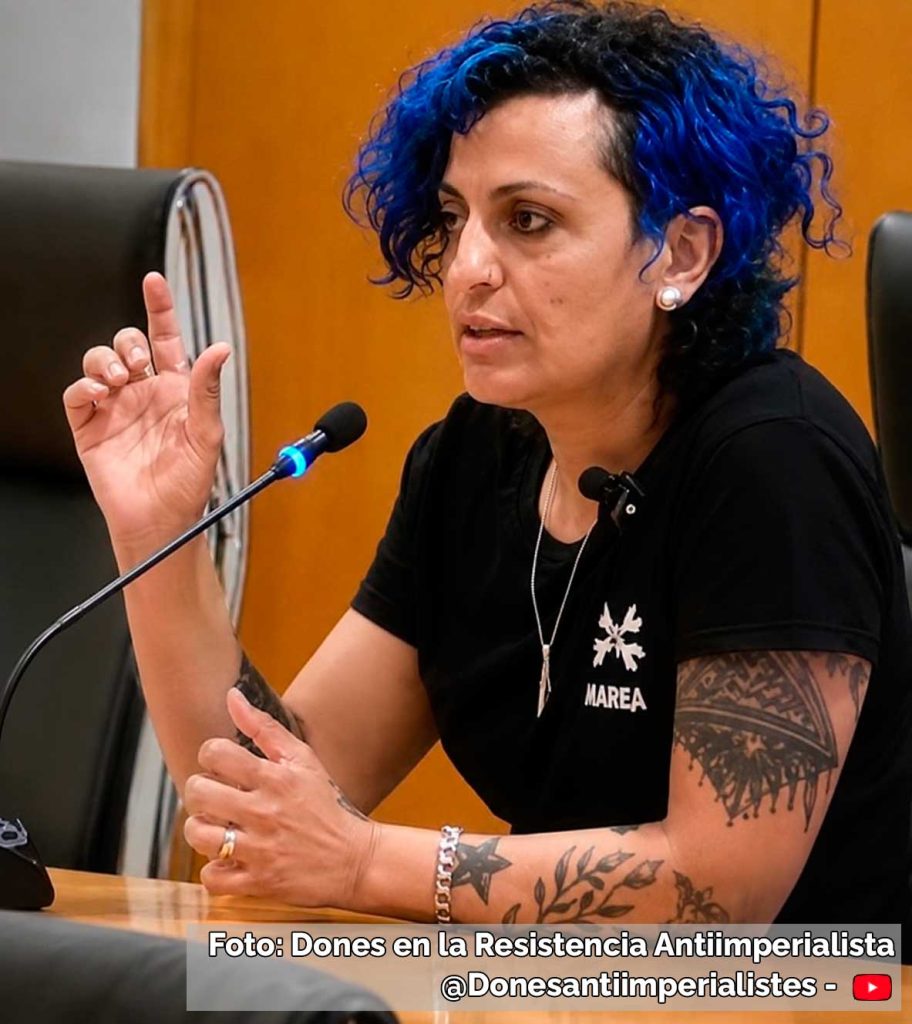
Mai Al Bayoumi
Mai’s voice: Palestine, a history of resistance that neither begins nor ends on 7 October
A greeting and a warning
Mai Al Bayoumi, a Gazan activist born in a refugee camp in Egypt and raised amidst displacement, opens her speech with a sincere expression of gratitude and a necessary warning: what is happening in Palestine is not an isolated incident, nor a passing trend, nor something that began three years ago and is about to end. It has a very long history, one that stretches back over a century. And although the violence has become so normalised that Palestine seems to be there, resisting, existing, almost like a wallpaper image, Mai will not allow that normalisation to continue unchallenged.
That is why, first and foremost, she asks for patience. She is going to give a brief but necessary historical overview, because without context, nothing can be understood.
The origins of Zionism: one idea, four countries and a choice
Zionism, Mai explains, began as an idea in 1897, when its founder proposed the creation of a Jewish state. At that time, four options were considered: Mozambique, Uganda, Argentina and Palestine. After several conferences, Palestine was chosen.
The Balfour Declaration, in 1917, was the pivotal moment. Great Britain, with strategic interests at the gateway to Asia, near the Suez Canal, declared its support for the creation of a national home for the Jewish people in Palestine. But Mai highlights something that official narratives often omit: the Palestinian cause has nothing to do with religion. There have always been Jews living in Palestine, as well as in Iran, Iraq and other countries. The problem is not a religious one. The problem is a colonial one.
Mai shows Zionist propaganda posters from the period: images of an elegant British gentleman pointing to a blank map of Palestine, with text in Hebrew reading ‘that is where we are going to live; that is our land’. Propaganda that repeated over and over again that Palestine was a land without a people for a people without a land. And, as Mai says, it was all lies.
The British Mandate and the Arab Revolt of 1936
In 1920, Britain established the British Mandate over Palestine. Settlers began to arrive, changing street names, laws and currencies. The Zionist occupation began, little by little.
Mai identifies 1936 as a turning point: the Arab revolt. In that year, she explains, the Palestinian people and the Arab countries began to realise what the Zionist plan really was. And it is not merely a plan to occupy a territory; it is the plan for ‘Greater Israel’ that we see today on the maps shown by Netanyahu himself. It is a colonial, racist project that does not recognise the existence of the Palestinian people.
Mai emphasises that this awareness did not arise in the upper echelons, but on the streets, in schools, in hospitals, within feminist movements, and amongst the working class. Because the Palestinian cause, she says, is a class cause. An internationalist and anti-imperialist cause.
The flag and the ‘Greater Israel’ plan
The Zionist flag, Mai explains, has a very specific meaning. The two blue stripes represent the Tigris and Euphrates rivers, which mark the boundaries of so-called ‘Greater Israel’. The Star of David symbolises a Jewish state. It is a profoundly racist project, because it aims to create a state exclusively for one religion, in a territory where multiple religions and entire peoples coexist.
That is the state they have sought to build from the very beginning: a colonial, racist state that leaves no room for those who do not fit into their project.
The Nakba and the refugee camps
In 1948 came the Nakba, the catastrophe. The State of Israel was recognised, and the forced displacement of entire villages began. People fled their homes with only the clothes on their backs, a key in their hand. That key became the symbol of the right of return.
Mai was born in a refugee camp in Egypt, on the outskirts of Cairo. It covered three square kilometres, home to more than 10,000 people. Without rights, without nationality, without the chance to study at university because refugees pay triple the fees. Unable to work in the civil service, as doctors or as lawyers. Just one school, one hospital, one market in the middle. Basic survival.
She explains that there are more than 70 Palestinian refugee camps both inside and outside Palestine: in Egypt, Jordan, Lebanon, Syria and also within Palestine itself. But each country treats refugees differently. Jordan is the only country that grants nationality to Palestinians. Eighty per cent of the world’s Palestinian population are refugees. And the main reason is that there is no right of return. Not even Palestinians who are displaced within the same territory, such as in Gaza, cease to be refugees.
“Eighty per cent of the Palestinian people are refugees, for one main reason: there is no right of return.”
The Intifadas and the shame of Oslo
Mai looks back at the first Intifada – the ‘Stone Intifada’ – which broke out in 1987. One day, at a checkpoint, an Israeli settler ran over four Palestinian workers with his car. The people rose up with stones. That was the first Intifada.
Then came the Oslo Accords in 1993. Mai describes them with a single adjective: shame. For her, and for many Palestinians, negotiating with the enemy is unacceptable. Their demands are clear. And they have nothing to do with the settlers’ religion, but rather with their actions. Israelis are not to blame for being born there, she says, but they are to blame for what they do.
Who is the Israeli settler?
Mai devotes a central part of her talk to explaining how the image of the Israeli settler is constructed. They are not just any human beings. They all do compulsory military service – men and women alike – for two to four years. There is no such thing as an anti-fascist or anti-colonial settler, because they all undergo the same military indoctrination.
Mai shows images of Israeli soldiers: fair-haired, smiling, looking like ‘decent people’. But that image, she says, is propaganda. They are the same people who kill Palestinians in the occupied territories and then go on holiday to relax and recount their battles. And when they speak, they never say ‘Palestinians’; they say ‘Arabs’. Because they do not recognise that Palestinians exist.
Mai also denounces the media’s double standards. Palestinian women wearing headscarves are portrayed as terrorists, whilst Israeli female soldiers, armed to the teeth, are portrayed as strong, powerful and attractive.
‘Suddenly a terrorist, but why? Because of anti-Islam propaganda. These women are veiled; they are religious, yes, but they are not terrorists – they are free too.’
Armed struggle as a right
Mai defends armed struggle as a legitimate right. But she also reminds us of something the West has forgotten: the Palestinian child you see with a stone facing a tank – that child has grown up. He has lived through all the injustice. And the struggle is going to change. The stone is replaced by a weapon, by dignity, by justice.
Editor’s note: The right of peoples under occupation to armed resistance is recognised under international law. UN General Assembly Resolution 37/43 (1982) reaffirms “the legitimacy of the struggle of peoples for independence, territorial integrity, national unity and liberation from colonial and foreign domination and from foreign occupation by all available means, including armed struggle” . This recognition is based on the right to self-determination, enshrined in the United Nations Charter and in earlier resolutions such as 2625 (XXV).
For Mai, 7 October was not an isolated incident. It was a revolutionary act. The Palestinian people have been living under military occupation for over 80 years. There are 10,000 people held captive in Zionist prisons, including children aged 6 and 7. But the West has normalised violence to such an extent that it only sees 7 October, not what led to it.
Mai gives an example that should give anyone pause for thought: in 2011, an Israeli soldier captured by Hamas was exchanged for 1,027 Palestinian prisoners. One for 1,027. That figure, she says, shows the value the State of Israel places on its soldiers and the utter contempt it feels for the Palestinians.
Hamas, the 2006 elections and the Islamic revolution
In 2006, Hamas won the elections in Gaza. Mai explains it clearly: it was not a religious issue. It was because the Palestinian people were fed up with the Palestinian Authority, which, following the Oslo Accords, had begun negotiating with the enemy and making concessions that led nowhere.
Mai describes herself as personally non-religious. But she respects the culture and religion of her people. Her mother is religious. And she understands that the Islamic revolution, today, is the revolution against imperialism. That is what must be understood.
‘Palestinians are religious. That’s just how it is. My mother is religious. But we have to understand the people, their culture, their religion, and we must respect them.’
Genocide and the fall of the Mossad myth
Mai denounces the fact that the genocide in Gaza was possible because Israel had been given the green light. But she also warns: imperialism acts with violence, with terror. Its language is terror. But the war, she says, has been lost. The Mossad, which believed itself to be the strongest in the world, has lost its reputation. They do not know how to fight on the ground. They only know how to use aeroplanes and tanks. The Palestinians, on the other hand, are rooted in the land, and they are not going to abandon it.
Mai welcomes the fact that the occupation of Syria, Lebanon and Yemen, and the attacks on Iran, demonstrate that the empire is coming to an end. And that, thanks to the Islamic revolution and the resistance, Palestine remains on the map and continues to be a topic of discussion.
Citizenship classes in Israel and the exodus of settlers
Mai explains the caste system in Israel: there are four categories of citizens. First, white Jews. Then, Latin American Jews – the Argentinians. Next, the Arabs. And finally, Africans. They all have dual nationality. All except the Palestinians.
And now, says Mai, 80,000 settlers have fled Palestine, like rats, because they have no love for the land. They are armed to the teeth, but as soon as things get ugly, they pack their bags and return to their countries of origin. Mai puts it bluntly: let them all go. Palestine is anti-racist; anyone can live there, but as a Palestinian.
A personal conclusion: the struggle for a secular Palestine
Mai declares herself to be personally non-religious. She fights for a secular Palestine, where religion does not govern. But she supports the Islamic revolution because it is the force that will put an end to imperialism and Zionism.
She concludes her speech by showing images of Palestinian women activists: the Mugrab sisters, who began as nurses during the British Mandate, founded a cultural centre and later the first Palestinian women’s organisation.
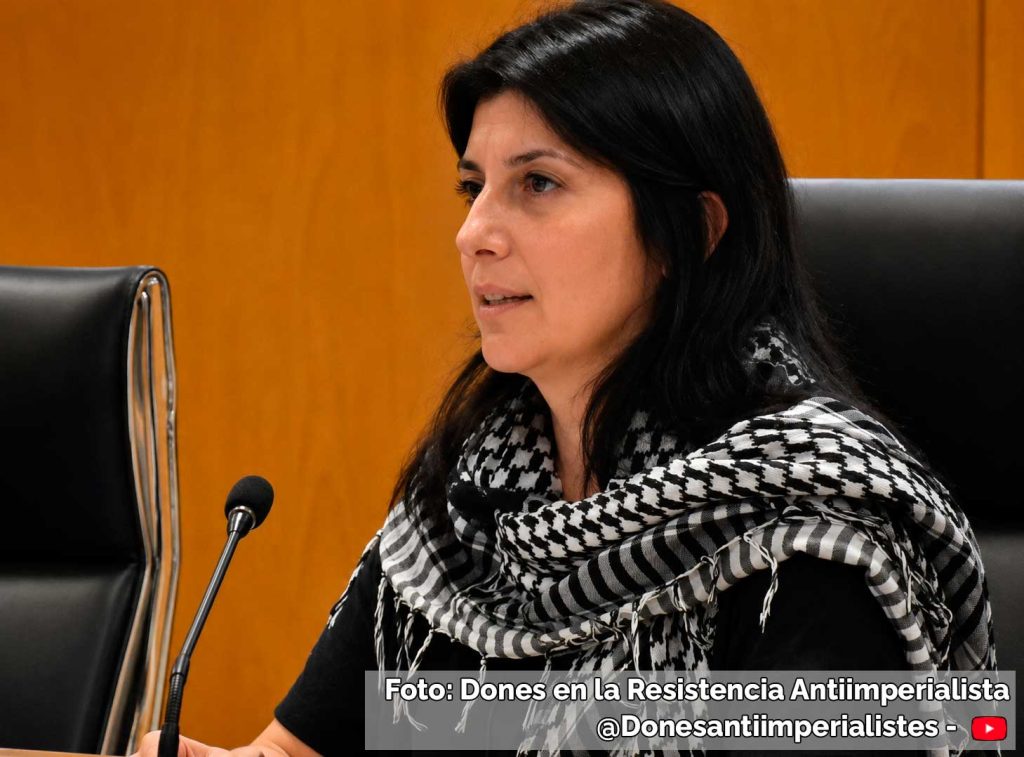
Mona Borghei
Mona’s voice: Iranian women, caught between progress and the imperialist siege
A legacy of resilience
Mona, an educator, lecturer in Persian literature and vice-president of the Iranian Canadian Congress, opens her speech with a warning that is also a statement of principle: what she is about to share is not a narrative written by others, but the living history of the women of her country. A history that the West has recounted many times, but almost always from the outside, through stereotypes or for the sake of political expediency.
In the face of this imposed narrative, Mona proposes another: that of Iranian women as protagonists on a long journey of resilience, education, achievements, activism and progress. But she also warns that this journey cannot be understood without acknowledging the shadows that have accompanied it: economic sanctions, wars and foreign interventions that have shaped – and continue to shape – the living conditions of women in Iran.
Her aim is not to discuss geopolitics or national security. Her aim, she says, is to analyse what these periods of instability and aggression have meant for women.
A necessary overview: women’s activism in Iran
To understand the present, Mona looks back more than a century. Women’s activism in Iran did not begin with the Islamic Revolution, nor was it a reaction to it. As early as the Constitutional Revolution of 1906–1909, women were organising themselves. The first school for girls was founded in 1906. The first women’s magazine appeared in 1910. However, when the Constitutional Law was drafted, women were denied the right to vote. This contradiction marked the beginning of a long struggle.
During the reign of Reza Shah, the state absorbed and controlled women’s organisations. In 1936, the policy of compulsory unveiling banned the wearing of the hijab. Mona highlights a point that is often overlooked: that coercive imposition was not a gesture of liberation, but one of the factors which, decades later, fuelled the 1979 Revolution.
Following the fall of Reza Shah’s dictatorship, between 1941 and 1953, Iran experienced a period of openness. Independent women’s organisations with diverse orientations emerged: left-wing, nationalist and religious.
Mona cannot discuss this history without mentioning the 1953 coup d’état, backed by the United States, which overthrew Prime Minister Mohammad Mossadegh. That coup, she points out, was another decisive factor that contributed to the 1979 Revolution.
In 1963, women were granted the right to vote. In 1967, the Family Protection Act was passed. But in 1979 came the Islamic Revolution, and with it a new landscape.
The post-revolutionary paradox
The West has persistently portrayed the 1979 Revolution as a step backwards for Iranian women, as a forced return to the home and to invisibility. Mona debunks this image with data. Statistics show that, in the decades following the Revolution, female literacy rose from 35 per cent to figures close to 80 or 90 per cent. Since the late 1990s, women’s participation in higher education has continued to grow.
Mona provides specific figures by academic field that highlight the scale of the change:
- In the Natural Sciences and Humanities, two of the most popular fields, women account for 67 per cent of all applicants – approximately two-thirds.
- In the Arts, female participation stands at 79 per cent.
- In Foreign Languages, around 68 % of applicants are women.
- In Mathematics and Engineering – the only field where men still outnumber women – women account for 37 per cent of applicants.
But there is a nuance that Mona considers essential, and which sociology has repeatedly highlighted: the more religious and traditional atmosphere that followed the Revolution meant that many conservative families, who had previously been reluctant to send their daughters to university for fear of a Westernised and modern environment, finally felt comfortable doing so. As a result, women from all social strata entered public life in unprecedented numbers. And these educated women eventually became the leading advocates for their own rights and for social change.
Iranian women have not only made progress in education. They are active in medicine, the knowledge-based industries, start-ups, business management, university teaching, literature and cinema. And also, as Mona emphasises particularly strongly, in sport.
‘I think it would be a shame not to mention the achievements of Iranian women in athletics, especially during a year in which the country endured two major wars against imperialist powers.’
In the last year alone, amidst two wars, Iranian women won 868 medals in international competitions, in disciplines such as volleyball, handball and numerous individual events.
The price of these achievements: bombs and missiles
Western imperialism, says Mona, celebrated these achievements by bombing.
On 28 February 2025, a new weapon was tested on the defenceless people of Iran. A bomb exploded in the sky and scattered 700,000 fragments over the city of Lamerd whilst the volleyball players were training. Twelve female athletes were killed – martyrs – and many girls were injured or died.
At the Shajareh Tayyebeh girls’ school in the city of Minab, two Tomahawk missiles claimed the lives of 168 girls and their teachers.
On 5 March, in a move that Mona describes as deeply ironic ‘in support of Iranian women’, the United States destroyed Tehran’s indoor stadium, with a capacity of 12,000 spectators, through a series of missile strikes. The complex, which included sports facilities, academies and student halls of residence, was completely razed to the ground. Its main users: women and girls.
‘All these events have laid bare the emptiness and falseness of the slogans that claim to support women.’
Mona does not dwell on the horror for the sake of horror itself. She does so to highlight a glaring contradiction: the very same countries that claim to defend the rights of Iranian women are the ones bombing their schools, their stadiums and their living spaces.
The silent impact of sanctions
Mona devotes a central part of her speech to economic sanctions, a regime she describes as “one of the most complex, comprehensive and multifaceted in the world”. These are not sanctions imposed by a single institution, but a tangled web of international measures and national laws from various countries which, taken together, have paralysed the Iranian economy.
And the impact, she warns, is not abstract. It falls particularly hard on women who have spent years striving to excel in education, sport, the arts and many other fields.
1. Job security and challenges in the labour market
The economic recession caused by the sanctions primarily affects the private sector, the service industry, small businesses and craft workshops – areas in which women make up a significant proportion of the workforce.
- In times of crisis, women are the first to lose their jobs and have the fewest opportunities in recruitment processes.
- Many are forced into the informal economy: street vending, home-based work, and jobs without legal protection or social security.
2. Increased pressure on female heads of household
Structural inflation and declining purchasing power directly affect women who bear the financial and administrative responsibility for their families.
- Providing housing and clothing, and coping with the rising cost of daily living, places unprecedented psychological and physical strain on women who are heads of households.
- Under these conditions, food insecurity arises. Low-income families are forced to cut nutritious foods and protein from their diets; the health of mothers and daughters is the first to suffer the consequences.
3. Healthcare
Whilst medicines and medical equipment are technically exempt from sanctions, banking restrictions and financial barriers have made the import of raw materials and specialised medicines extremely difficult and costly.
- Access to medicines for women’s health conditions such as breast and cervical cancer has been severely restricted, and the supply of screening equipment has been disrupted.
- The skyrocketing prices of prenatal supplements, childbirth costs and infant formula are placing enormous pressure on families, particularly on young mothers.
4. The impact on girls’ marriage age
In low-income families facing severe economic pressure due to the sanctions, this unfortunately leads, in some cases, to girls dropping out of school and contributes to a rise in child marriage as a strategy to reduce household expenses.
Child marriage is one of the issues that Western media often highlight when discussing Iran. However, the role of economic hardship and cultural deprivation – conditions exacerbated by these far-reaching economic sanctions – is often completely overlooked in these debates.
The domino effect and the complicity of certain narratives
Sanctions act like a domino effect. First, they cripple the wider economy; then, their most devastating impact falls on the most vulnerable: women.
And here Mona makes one of her most scathing criticisms. The very same educated women who have managed to make their mark in technology, medicine or entrepreneurship are now portrayed by Western imperialism as the very group they claim to defend through initiatives such as the campaign against ‘gender apartheid’. Hillary Clinton, Mona explicitly mentions, has supported and promoted these projects.
But within these movements, she says, scant attention is paid to the real effects of sanctions on women seeking independence and self-sufficiency.
‘These movements claim that sanctions weaken governments. However, women entrepreneurs and start-up founders — women who, over recent decades, have carved out a place for themselves in Iran’s tech ecosystem thanks to their education, experience and creativity — now find themselves on the front line of the crisis caused by these sanctions.’
The impact of sanctions on women entrepreneurs and start-ups
1. The main barrier: lack of access to international tools (technology blockade)
Many start-ups rely on global tools for their development, marketing and management. Technology sanctions, whether imposed by governments or by major tech companies, have dealt a severe blow to women entrepreneurs.
- Restricted access to cloud services and artificial intelligence: Essential platforms such as Google Cloud and Amazon Web Services (AWS), as well as analytics and marketing tools like Google Analytics and AI development platforms, have blocked Iranian IP addresses. Women entrepreneurs are often forced to invest large sums of money in proxy servers and alternative solutions, such as dedicated VPN services, which also increases the risk to data security.
- Removal from international app stores: The removal of Iranian apps from Google Play and the App Store has severely limited the ability of women-led start-ups in the retail and services sectors to reach a wider audience.
2. The funding crisis and the withdrawal of foreign investors
A start-up requires ongoing investment to survive and grow.
- As sanctions intensified, foreign venture capitalists interested in investing in innovative ideas developed by Iranian women withdrew from the Iranian market.
- Within Iran itself, structural inflation caused by the sanctions has redirected investment towards traditional markets such as gold, foreign exchange and property. As a result, domestic investment funds have been less willing to take risks on innovative ideas proposed by women entrepreneurs.
This has contributed to what might be described as the ‘death of start-ups’ in their early stages.
3. The closure of international markets and foreign exchange earnings
Many women entrepreneurs have worked in areas such as the creative industries, performance-based marketing, modern carpet and fashion design, and online consultancy – fields with great potential for the export of services.
- The payment gateway crisis: Due to banking sanctions, access to international payment systems such as PayPal and Stripe is impossible. As a result, women-led start-ups are unable to serve international customers or generate foreign currency revenue. Their growth potential is limited to the small domestic market.
4. Brain drain and the loss of start-up teams
Women entrepreneurs report that, after months of effort spent building and training start-up teams, they lose key members due to the ongoing brain drain. Limited budgets prevent them from competing with salaries paid in dollars or with large international companies.
The other side of the coin: resilience and innovation under sanctions
Despite all these obstacles, women’s entrepreneurship in Iran has not come to a complete standstill. On the contrary, these pressures have given rise to a phenomenon that could be termed ‘entrepreneurship in times of crisis’.
- Localisation of tools: Women working in technology have sought to develop domestic alternatives to international platforms subject to sanctions.
- Focus on local economies and direct marketing: Many women have adapted their business models by using both domestic and international social media platforms, prioritising direct sales and local supply chains to reduce reliance on imports.
Sanctions have not dampened the motivation, creativity or determination of Iranian women entrepreneurs.
War as a continuation of sanctions
Mona draws a direct link between economic pressure and war. Sanctions, she says, laid the groundwork for a conflict that has cast a shadow over the lives of the Iranian people for years.
On 12 June 2025, Israel violated Iran’s airspace. Of the 1,062 people killed, 700 were civilians, including 126 women and 47 children. Nurses, the vast majority of whom were women, worked gruelling shifts to care for the 5,800 wounded.
Rising inflation and severe damage to digital businesses also undermined the financial independence of many women, particularly female heads of households.
During the Ramadan War, the most recent conflict – known in Iran as the Third Imposed War, because much of it took place during the holy month – Tehran alone was hit by 650 bombs and missiles, with a further 13,000 striking various parts of the country. Nearly 4,000 people were killed and 30,000 injured. 220 children lost their lives and 1,997 children and adolescents were injured.
The psychological consequences, Mona emphasises, fall most heavily on mothers.
The figures she provides are overwhelming:
- 170,000 homes completely destroyed.
- 480 industrial and manufacturing facilities razed to the ground.
- 2,200 production units damaged.
- 1,200,000 people out of work, of whom 550,000 are women.
Added to this are teachers, nursery carers, staff at private clinics, retail workers and many others who have lost their livelihoods.
‘In times of war, survival becomes the priority; expectations are scaled back and social movements become a luxury compared to the struggle for survival. War transforms all social demands — including the rights of women, workers and teachers — into secondary concerns.’
The false promise of imperialism
Mona makes no secret of her outrage, but she expresses it with a clarity that goes beyond mere rhetoric. She has shared all this information, she says, to remind us of something that many already know but which is often silenced: what imperialism offers under the banner of supporting Iranian women is nothing more than a deception.
Western imperialism continues to justify military aggression and economic pressure by portraying Iranian women as prisoners of tradition and religion. But the statistics — the figures on literacy, university enrolment, sporting medals and entrepreneurship — tell a very different story.
‘If Iranian, Lebanese, Palestinian, Iraqi, Syrian, Afghan and Yemeni women had not endured years of war, sanctions and economic pressure, they would undoubtedly have participated, alongside women from other parts of the world, in the production of knowledge, science and innovation.’
Mona denounces the West’s obsession with the hijab and women’s dress as a distraction that ignores historical roots, traditions and cultural differences, whilst serving as a pretext for military intervention and the funding of projects such as so-called ‘gender apartheid’.
But non-Western women, she emphasises, are not passive beings incapable of action. Without relying on humanitarian aid that arrives via coups, bombs and missiles, they have forged their own paths to progress, shaped by their histories, their cultures and their environments.
Resistance as a living response
The final part of Mona’s speech is a testament to living resistance. Since 28 February, when the Iranian leader was assassinated in what can be described as a terrorist attack on his home and office, along with members of his family and several military commanders and advisers, women have gathered in city squares every night for 100 consecutive nights. Without rest. Without interruption. So that the enemy would know that, under any circumstances, the people — and especially the women — support their armed forces and their government.
Through community centres and help points, professional women provided free medical and educational services to their fellow citizens. They prepared food for the children attending the rallies with their parents. They organised games and activities for them.
Mona concludes with a symbol that transcends words: a flag, stained with the blood of a woman killed in the attack during the Al-Quds Day march on 13 March. That woman, and all those who took part in that march, knew the enemy might attack. Yet they went anyway. Yet they gave their lives.
‘This is the beauty of resistance and martyrdom.’
Two voices, one truth
When Mai’s account meets Mona’s — the voice of Palestine and the voice of Iran — this document fulfils its purpose: to offer a faithful, well-documented and respectful testimony from two women who, drawing on two distinct national experiences, share a common theme: anti-imperialism and resistance.
It is not a question of merging their voices into one, but of placing them side by side, as was done at that event in Valencia on 18 June 2026, so that the reader may hear them separately and, at the same time, understand how they engage in dialogue.
Mai speaks from the perspective of the Nakba, the refugee camps, the Intifadas and the siege of Gaza. Mona speaks from the perspective of sanctions, imposed wars and the resistance of Iranian women against imperialism. But both agree on the essential point: imperialism does not liberate, it oppresses. It does not defend, it bombs. It does not listen, it imposes.
Both denounce the double standards of the media and hegemonic discourses. Both assert the agency of their peoples. Both affirm that women are not passive victims, but active protagonists of the resistance.
Because, as Mai and Mona have made clear, the women of Palestine, Iran, Lebanon, Syria, Iraq, Afghanistan and Yemen are not passive subjects of history. They are protagonists. And their voices, recorded here, serve as a reference document for those who, in years to come, wish to understand what was said, why it was said, and how two experiences of resistance found common ground on which to share their truth.